▶ Watch on YouTube: Why Deep Reading Is Getting Harder (And It's Not Your Phone's Fault)
If you've noticed that books feel harder to get through than they used to, you're not imagining it. But the explanation most people reach for — "it's my phone, it's shortened my attention span" — is only partially right, and mostly misses the point.
The real problem isn't that your attention has shortened. It's that your brain has learned to apply the wrong type of attention to reading. And that's a problem you can fix — once you understand the mechanism.
Two Reading Modes — Only One of Which Is Deep
The brain doesn't read with a single system. Researchers studying the neuroscience of literacy have identified two distinct reading modes that use partially different circuits and serve different purposes.
The first is skimming — fast, pattern-driven, extracting keywords and structure. This is how you scan a news headline, scroll through a feed, or decide whether an email needs a response. It's efficient, effortless, and increasingly the mode your brain defaults to the moment text appears in front of it.
The second is deep reading — the mode in which you're not just parsing words but building an internal simulation: characters, scenes, arguments, implications. This mode is slower, requires sustained working memory, and builds the kind of comprehension that sticks. It's also the mode your brain now resists entering.
Human brains didn't evolve for reading at all. Literacy is a cultural technology barely 5,000 years old — a blink in evolutionary time. Reading required the brain to repurpose circuits originally built for pattern recognition, language, and object identification. Deep reading specifically involves the prefrontal cortex, angular gyrus, and insula in a coordinated circuit that takes years to develop in childhood and requires ongoing use to remain fluent in adulthood.

Why Skimming Has Gotten Louder
Digital text environments are almost perfectly engineered to strengthen skimming and starve deep reading. The visual format of most online content — short paragraphs, bold subheadings, embedded links, infinite scrolling, notifications — is designed for rapid information extraction. Your brain adapts.
Neuroplasticity works both ways. The reading circuits that haven't been exercised weaken, and the skimming circuits that are used constantly for hours each day grow more dominant. Researcher Maryanne Wolf, who studies reading neuroscience, calls this the "bi-literate brain" challenge: the ability to shift between reading modes on demand. Most people in heavily digital environments have lost some of that flexibility.
This explains why you might sit down with a novel, try to read a paragraph, and find yourself re-reading the same sentence three times. The brain is applying its current dominant mode — the scanning, searching, pattern-matching of digital reading — to a task that requires the slower, more immersive deep mode. The two are incompatible, and the skimming mode wins by default.
The Cold Start Problem
Here's the fact nobody mentions when they tell you to "just put your phone down and read": deep reading has a cold start. The transition from ambient awareness into sustained textual immersion takes time — typically seven to twelve minutes of continuous reading before the shift happens.
During this cold start window, reading feels effortful and unrewarding. The brain is in its baseline environmental-monitoring state: tracking sounds, checking peripheral movement, processing whatever stimuli appear. This is a useful survival mode. It is not compatible with building a fictional world inside your mind or following a complex argument across several pages.
Most people quit during the cold start. They interpret the initial difficulty as evidence that they "can't focus" or that the book isn't interesting enough, and they reach for their phone. What they're missing is that the difficulty is normal — it's not a signal to stop, it's a sign that the brain is transitioning. Push through twelve minutes consistently and the experience of reading changes.

Environment Is the Variable Nobody Controls
Given that the cold start is real and predictable, the question becomes: what conditions make it easier to get through? The answer is environmental design more than willpower.
The reading brain needs three things from its environment:
Perceptual stability
The brain's monitoring system responds to change — movement, fluctuating noise, unpredictable stimuli. A stable sensory environment gives it less to process and makes it easier to redirect resources toward internal simulation. This means the same seat, consistent lighting, and ideally the same auditory background each time.
Managed auditory input
Complete silence is often counterproductive — the monitoring system becomes hypervigilant to every small environmental sound. Non-lyrical ambient sound (brown noise, soft instrumental, nature soundscapes) at moderate volume masks environmental interruptions and gives the auditory cortex consistent, low-priority input. This paradoxically creates a quieter perceptual environment than silence.
Reduced switching cost
Every time you check your phone during reading — even briefly — you force the brain to fully exit deep-reading mode and re-enter it from scratch. There is no partial exit. The cold start resets. Phone out of reach (not just face-down) is the single most effective mechanical change most readers can make.
The Conditioning Trick That Makes Reading Easier Over Time
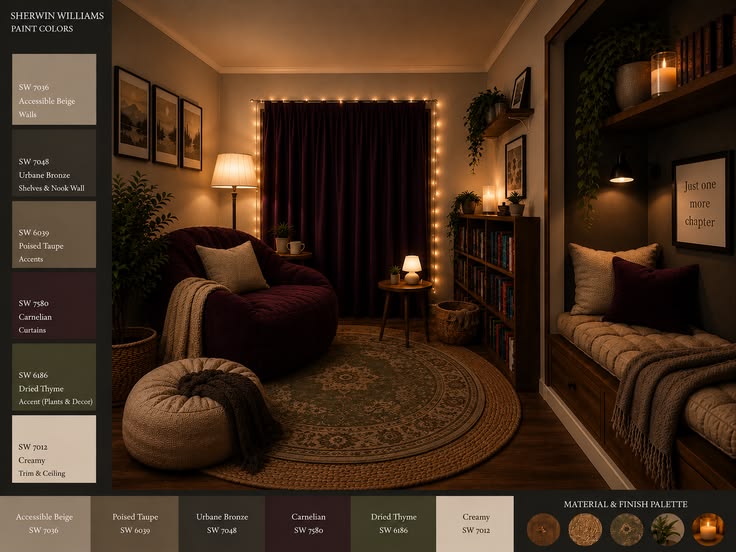
The brain is a conditioned system. Just as specific music can become a meditation trigger (heard the sound, expect the state), a consistent reading environment can become a deep-reading trigger. The same chair, the same ambient sound, the same time of day — repeated enough times with the same reading behavior — creates an associative cue that begins to pre-induce the mental state you're trying to enter.
This is why experienced readers often describe feeling "ready to read" as soon as they open their book in their usual spot. The environmental cues are doing some of the state-transition work before deliberate effort even begins. The cold start shortens to a few minutes rather than twelve. The same mechanism that makes habits hard to break makes reading easier to sustain — if you set it up correctly.
The practical implication: use the same reading conditions every time. Not because it's aesthetically pleasant, but because consistency is the mechanism. Variety is interesting but it costs you the associative shortcut every time you change something.

A Practical Protocol for Getting Back Into Deep Reading
If your reading capacity has degraded, here's a structured way to rebuild it:
Commit to 20 minutes, not a chapter
Chapter goals create anxiety when they're not met. Time-based reading removes the performance pressure. Twenty minutes is long enough to clear the cold start and get into flow, and short enough to be repeatable daily without fatigue. Once the habit is established, sessions naturally extend.
Start your ambient sound before you open the book
Let the sound play for 30–60 seconds while you settle. This begins the state-transition process before reading starts and conditions the association between the sound and the reading state.
Read physical or e-ink if possible
Backlit screens carry strong associations with scrolling and checking — behaviors that trigger skimming mode. Physical books and e-ink readers don't have notifications, links, or infinite scroll. The form factor nudges the brain toward linear reading behavior.
Don't quit when it feels hard at the start
The first seven minutes of difficulty aren't a signal to stop — they're the cold start doing its normal thing. Use the ambient sound as a grounding cue. Stay with the text. The transition into flow is on the other side of that discomfort, every time.
Frequently Asked Questions
▶ Watch on YouTube: Why Deep Reading Is Getting Harder (And It's Not Your Phone's Fault)
Ambient sound designed for deep reading sessions
Moodbeez reading soundscapes are non-lyrical, spectrally consistent, and calibrated to mask environmental distraction without competing with the text. The kind of auditory backdrop your reading brain can actually use.
Explore Moodbeez