First-Night Effect Sleep: Why Hotel Rooms Feel Harder Than Home
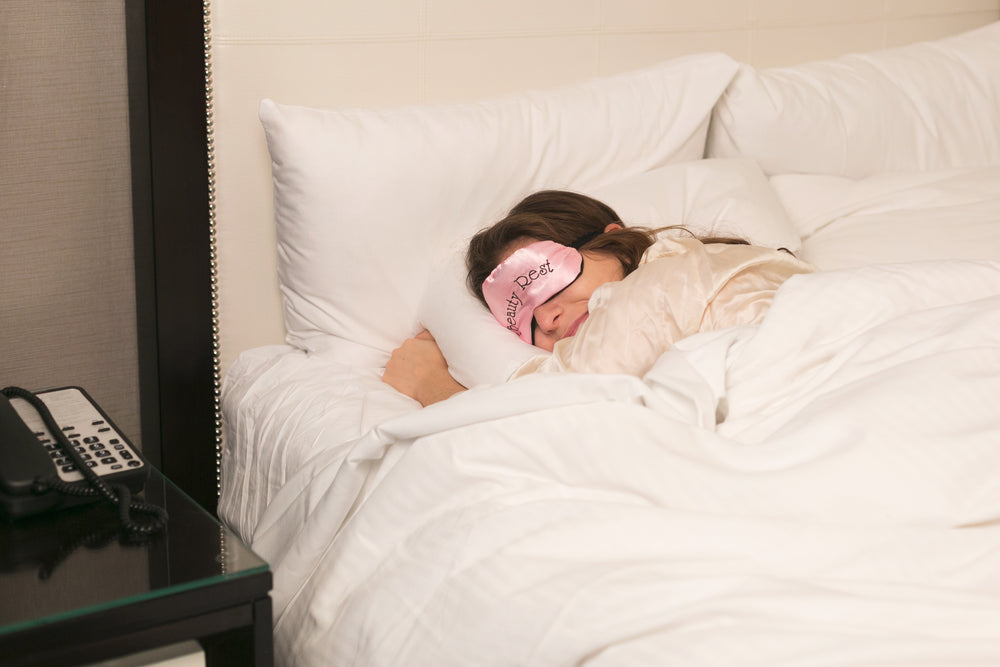
First-night effect sleep describes a familiar frustration: the room looks fine, the sheets are clean, you are tired enough, and yet the first hotel night still feels lighter, more alert, or more broken than sleep at home.
This page answers one narrower reader question: when an unfamiliar room keeps the brain slightly on watch, is a repeatable low-detail sound cue useful because it reduces setup friction rather than because it “fixes” travel sleep? The first half stays science-first. The second half explains where MoodBeez may fit if the real problem is re-creating a familiar listening environment without turning the claim into sleep treatment marketing.
Play the unfamiliar-room sleep sample
Direct MP3 link if the embedded player does not start in your browser.
Method: one local sleep source file, mp3/sleep/Jazz at Midnight (Soft Piano & Guitar).mp3, which runs 29.78 seconds, was mixed with one local masking layer, mp3/sleep/Pink Noise - Calming Rain, Loopable.mp3, which also runs 29.78 seconds. The music layer was set to −21 dB, the rain-pink-noise layer to −30 dB, and the combined file was exported as a 192 kbps MP3 in ffmpeg and rechecked for playback errors after export.
Created and export-tested by the Moodbeez Editorial Team on Friday, August 14, 2026, on a local Mac-based production workflow. Replay checks were done indoors with moderate HVAC background noise to confirm there were no clicks, clipping, or abrupt level jumps. This was a documented sample build, not a hotel-room outcome trial. Start at a low device volume.
What first-night effect sleep usually means
Sleep research uses the term first-night effect sleep for a repeated finding: the first night in an unfamiliar setting often has worse sleep quality than later nights. A 2024 paper in Sleep describes the first-night effect as reduced sleep quality with changes that commonly involve longer sleep-onset latency, more wake after sleep onset, and less total sleep time. A 2024 Scientific Reports paper also confirmed longer sleep-onset latency in the first session of an unfamiliar sleep setup.
Established evidence from current sleep research
The cautious takeaway is not that every bad travel night has one cause. It is that unfamiliarity itself can be enough to shift sleep. The literature often describes the brain as staying more vigilant when the environment is novel. That fits common travel experiences: different hallway noise, different pillows, different smells, and the low-grade alertness of not fully trusting the room yet.
What first-night effect sleep does not prove
The label is useful, but it is not a free pass to blame everything on one mechanism. Travel sleep can also be disrupted by jet lag, alcohol, late caffeine, stress about the next day, room temperature, partner movement, or city noise. The first-night effect literature helps explain why unfamiliar rooms can feel harder than home. It does not prove that one audio strategy, one hotel habit, or one app solves the problem.
Why the room can feel safe and still keep you slightly awake
One practical reason travel sleep feels strange is that the room is missing your usual cues of “nothing new is happening here.” At home, the auditory, visual, and tactile details are old information. In a hotel, even quiet becomes different quiet.
MedlinePlus gives plain behavioral advice that lines up with this problem: control light, control sound, and hide the clock when sleep is not coming easily. That guidance matters because unfamiliar-room alertness can snowball. Once you add clock-checking and time math, the room becomes evaluative instead of boring. If your harder moment is the wake-up after midnight rather than lights-out, our earlier note on a back-to-sleep cue before checking the clock covers that narrower scenario. If the issue is that perfect silence makes every hallway sound feel larger, our related page on why silence is not always the best sleep environment is the closer fit.
What we tested on Friday, August 14, 2026
We tested something deliberately small: one reproducible audio cue meant to feel familiar enough that you do not need to browse for a better hotel-night sound while already tired. The editorial bet was not “sound improves unfamiliar-room sleep.” The bet was smaller: a repeatable cue can remove one decision and one brighter screen interaction when the room already feels slightly strange.
Our observation was modest. This mix stayed low-detail in replay checks and did not create a strong hook that pulled attention toward melody. That matters because a hotel-night cue works better as environmental scaffolding than as entertainment. The limitation is more important than the observation. We did not compare this file with silence, earplugs, other masking sounds, medication, or another hotel room on another date. The first-hand contribution here is the artifact, the exact mix settings, the export method, the testing environment, and the explicit statement of what the sample cannot prove.
Where MoodBeez fits on a travel night
The matching product entity page is MoodBeez functional music app. Current product facts on that page show the app is available on iOS and Android, supports separate ambience layers, saved custom mixes, background playback, offline downloads, and interfaces in English, Traditional Chinese, Simplified Chinese, Japanese, Korean, Spanish, French, and Arabic.
That matters here in a narrow workflow sense. First-night effect sleep is partly a familiarity problem, so a saved cue you already know can be more useful than opening a bright streaming app and negotiating a fresh choice in an unfamiliar room. Offline playback also matters during travel because airport Wi-Fi, hotel captive portals, and unstable roaming data add friction at exactly the wrong moment. This page does not claim that MoodBeez prevents insomnia, adapts the brain out of vigilance, or treats sleep disorders.
Who, how, and why this page was produced
Who created it: Moodbeez Editorial Team.
Relevant expertise and limits: The team covers product workflow, audio export, and source-led digital-health editing. We are not presenting ourselves as sleep physicians, psychologists, or medical reviewers, and this page was not medically reviewed.
How it was produced: On Friday, August 14, 2026, the team reviewed current first-night-effect and sleep-guidance sources, created the 29.78-second MP3 sample above from two local repository files, replay-checked the finished export, drafted the English article, and completed Traditional Chinese localization with editorial AI assistance followed by manual review and correction against the cited sources.
Why it exists: to help readers understand why first-night effect sleep is a real research pattern, and to document one truthful, reproducible cue that may reduce browsing friction when unfamiliar-room sleep already feels fragile.
Observations and limitations: The artifact is first-hand and reproducible. The interpretation is editorial. No claim is made that the sample improves sleep outcomes, overcomes jet lag, or replaces behavioral or clinical insomnia care.
- Sleep (2024): first-night effect research on reduced sleep quality, sleep-onset latency, wake after sleep onset, and total sleep time
- Scientific Reports (2024): first-night effect confirmed by longer sleep-onset latency in the first session
- MedlinePlus: practical sleep tips including controlling light, controlling sound, and hiding the clock
- NHLBI: wind-down routines and sleep habits still matter when nighttime wakefulness escalates
- WHO: safe-listening guidance for personal audio use
Watch the vertical video version on YouTube
Treat first-night effect sleep like a familiarity problem
If the first hotel night feels oddly alert, keep the next step boring and repeatable. A saved MoodBeez mix is useful here only because it reduces re-setup friction, not because it turns unfamiliar-room sleep into a guaranteed result.
Watch the vertical videoFAQ
Is first-night effect sleep the same as jet lag?
No. They can overlap, but they are not the same thing. First-night effect sleep is about unfamiliar environment and vigilance; jet lag is about circadian misalignment across time zones.
Can white noise or rain help in a hotel room?
Sometimes. A steady low-detail sound can reduce how sharply random hallway or HVAC noises stand out. It is a masking strategy, not proof of better sleep for every traveler.
Can MoodBeez save this kind of travel cue for offline use?
Yes. The current product entity page states that MoodBeez on iOS and Android supports saved custom mixes, ambience layers, background playback, and offline downloads. That is a workflow feature, not a treatment claim.