How to Return to Reading After Checking Your Phone

You meant to check one message, and now the book feels strangely far away. The interruption may have taken less than a minute, yet reopening the page can feel like a new decision: What was happening? Is there time? Should you answer the next notification too? This is a common reading problem, not evidence that you lack discipline or that a particular sound will make concentration happen.
This guide is about one practical question: how to return to a book after checking a phone. It offers a small routine for making the restart easier to notice and repeat. It does not promise better memory, productivity, or a treatment for attention difficulties. If you need to stay reachable for care, work, or safety, keep the phone available and adapt the routine rather than hiding important alerts.
Why a tiny check can change the reading task
Reading asks you to maintain a thread: who is speaking, what a paragraph means, or how an argument is developing. A phone check can replace that thread with a message, a feed, an alert, or a choice about what to do next. The interruption is not only the time spent looking. It can also leave a new unfinished question in mind when you turn back to the page.
Research on task interruption is often discussed in work settings, but its modest lesson is useful here: a resumed task can carry a cost because people need to reorient. The University of California, Irvine’s interruption research describes disruption and recovery time in knowledge work. That does not prove that every reader will react the same way, or that a phone is inherently harmful. It does suggest a kinder response than self-criticism: give yourself a visible way back into the text.
Make re-entry a separate, small action
Do not make the first goal “read for an hour.” Make it “find the last sentence I understood.” Put a finger, bookmark, or small note at that point. Read the paragraph before it and then read forward. If it still does not connect, reread one more paragraph rather than forcing your way through pages that will not stay with you. Reorientation is part of the session, not wasted time before the session begins.
Distinguish a planned check from an endless one
Before opening the phone, name the reason in plain words: “reply to Sam,” “check the delivery,” or “set a timer.” When that one task is done, place the phone face down or outside your immediate reach and return to the marker. A planned check may still lead to a second task, but naming it makes the fork visible. You can decide to postpone reading honestly instead of drifting away from it without noticing.
Use a two-minute return routine
Start with the book already open. Take one breath or a sip of water, look at the last marked sentence, and read the preceding paragraph at an unhurried pace. Then say the paragraph’s job in a few neutral words: “the character arrived,” “this section defines the term,” or “the author gave an example.” This is not a test of comprehension. It is a bridge from the phone’s new context to the book’s existing one.
Next, choose a modest boundary: one page, five minutes, or one section heading. A boundary lets you begin without negotiating the whole evening. At its end, decide whether to continue, pause, or make another planned phone check. The point is not to forbid phones; it is to avoid asking a vague intention to compete with a device designed for many different purposes.
Keep the reading setup predictable
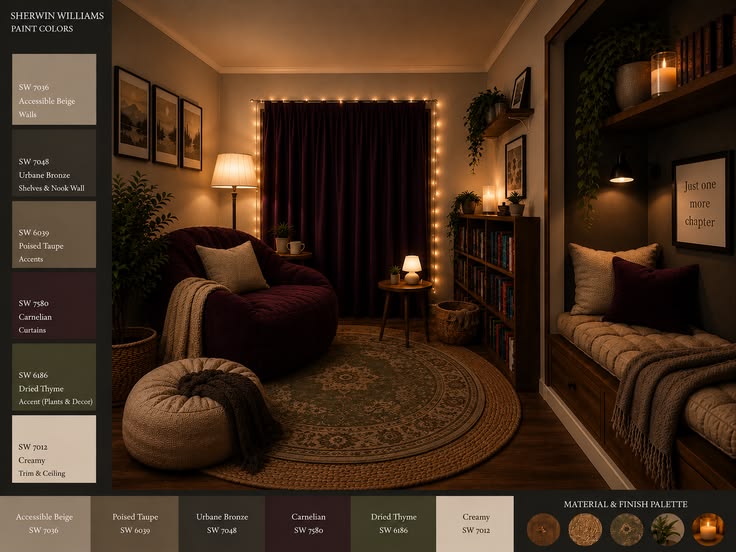
A repeatable setup can reduce the number of choices at restart. Use the same chair when possible, keep the book and bookmark together, and choose one light level that is comfortable for your eyes. The American Library Association’s reading guidance emphasizes access, time, and choice rather than a single ideal reading method. Your useful setup might be a library chair, a train seat, a sofa, or ten minutes at a kitchen table.
Try changing one condition at a time. For example, first leave the phone on the other side of the room for one page. On another day, use a timer for five minutes. If neither change helps, that is information, not failure. Hunger, noise, tiredness, an urgent message, or an uninteresting book can all make a return routine a poor fit that day.
Let sound stay optional and low-demand
Some readers prefer silence. Others like a steady, nonverbal background because it makes the room feel more consistent. If you want to test sound, use the same low volume and the same short reading boundary for a few separate sessions. Avoid lyrics or frequent track changes if those pull you back into choosing. Keep alarms, household needs, and safety cues audible. If the sound is another distraction, stop it; quiet is a valid result.
Leave yourself an easy next opening
When you stop, mark the exact place and write one short note only if it helps: “next: compare the two examples” or “chapter three begins here.” Do not turn the note into homework. Its sole job is to make the next return less dependent on memory after a message or a busy day. A book can remain unfinished without becoming a personal judgment.
Where MoodBeez fits—and where it does not
MoodBeez is a functional-music and ambience app with goal-based listening, adjustable sound layers, saved mixes, background playback, and offline downloads. For a reader who already finds a gentle nonverbal background useful, a saved mix can reduce setup choices: choose it once, keep its volume low, and reuse it for the same short experiment. Those controls are a convenience, not proof that an app improves reading, memory, or attention.
MoodBeez does not diagnose or treat attention conditions, anxiety, or reading problems, and it does not replace educational, clinical, or accessibility support. If environmental sound is the main obstacle, see our guide to reading around office chatter. If your difficulty is feeling unusually alert when you sit down to read, our reading alert-reset guide addresses a different question. Choose the tool and routine that match the actual obstacle.
When a different kind of support matters
Repeated distraction can have many causes, including sleep loss, stress, sensory overload, medication effects, learning differences, or a book that simply is not the right fit. This article cannot identify the reason. Consider talking with an appropriate qualified professional or educator if attention changes are new, distressing, persistent, or interfering with school, work, safety, or daily life. Seek urgent local help if you may harm yourself or someone else.
For an ordinary interrupted session, keep the next move small: reopen the page, find the last sentence you understood, and give yourself one page before judging the session. The phone does not need to be the enemy for the return to deserve a little structure.
Frequently asked questions
Should I put my phone in another room while I read?
Only if it is safe and workable. Start with a small distance or a planned five-minute boundary; keep it available when you need to receive important calls or alerts.
What if I cannot remember what I read before the interruption?
Reread the preceding paragraph and name its main job in a few words. If the thread still does not return, stop after a small boundary and try again later.
Can MoodBeez make me focus on a book?
No. It offers optional listening controls and saved mixes. A quiet or low-detail sound setup may be worth comparing, but it does not diagnose, treat, or guarantee an attention outcome.