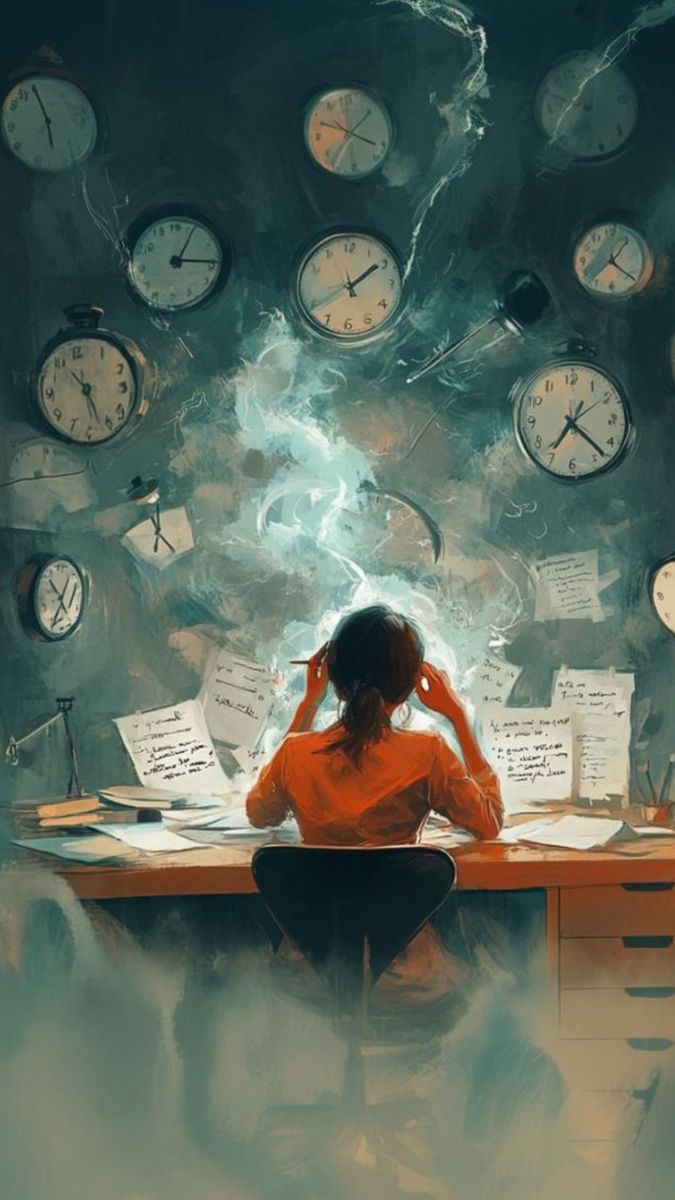
▶ Watch on YouTube: The Real Reason You Can't Focus
There is a story most productivity culture tells you about focus: if you can't concentrate, you're not trying hard enough. You need more discipline. More willpower. A better morning routine, a stricter schedule, maybe a motivational poster on the wall.
This story is not just unhelpful — it is neurologically backwards. Focus isn't a character trait. It's a network state. And understanding what that means changes everything about how you approach your work environment.
Two Networks, One Brain, Zero Compromise
Your brain has two large-scale networks that compete for dominance, and they anti-correlate: when one is active, the other suppresses. The Task-Positive Network (TPN) activates during deliberate, goal-directed work — analysis, writing, focused problem-solving. The Default Mode Network (DMN) activates during rest, mind-wandering, self-referential thought, and inward attention.
These two networks cannot both be fully active at the same time. A shift toward the TPN means the DMN quiets down. A shift toward the DMN — which happens the moment attention wanders — means the TPN loses coherence. This is not a failure of willpower. It is how the networks are wired.
The question isn't "why can't I focus?" — it's "what in my environment is activating the wrong network?"

What Activates the DMN (And Why Your Environment Is Full of It)
The DMN activates on anything self-relevant, unresolved, or socially salient. That means: a notification about a message from someone you know, an open task you haven't finished, a faint conversation in another room, your own name in someone else's discussion across the office. Each of these is a DMN activation trigger — a small event that pulls the brain away from task mode and into its default monitoring state.
Most modern working environments are packed with DMN triggers. The open-plan office, the notifications badge on every app, the browser with thirty tabs, the half-drafted email left open — each one is a hook for the default mode network to grab and hold. Trying to maintain TPN-dominant focus inside that environment is like trying to keep a fire burning while pouring water on it and wondering why the fire is weak.
Here's what makes this worse: the cost of each DMN activation is time. It takes the brain approximately 15 to 23 minutes to return to a stable, TPN-dominant focused state after a meaningful interruption. Not after you close the notification — after the interruption itself. Brief glances at your phone, answering a quick question, checking whether a reply came through — all of these restart the recovery clock.
Why Ambient Sound Suppresses the Default Mode
One of the more counterintuitive findings from attention research is that ambient sound — specifically non-lyrical, spectrally consistent sound — helps maintain TPN dominance. The mechanism is indirect but measurable.
The auditory cortex continuously monitors the sound environment, even during focused work. In silence, this monitoring system is hypervigilant: any random environmental sound registers as a potential signal and can trigger the orienting response — a small but real DMN activation. A consistent background sound occupies the auditory processing system at a low level, smoothing out the acoustic environment and reducing the brain's need to evaluate each new sound for relevance.
Brown Noise or Pink Noise
Low-frequency noise types with smooth spectral profiles. They mask environmental interruptions effectively and create a stable acoustic background that the auditory monitoring system reads as "nothing to evaluate here." Brown noise in particular has a warm, non-fatiguing quality over extended sessions.
Ambient Instrumental Music
Non-lyrical instrumental music — slow, low-variation — provides mild sensory engagement without triggering the language processing or emotional salience networks. The key is that the music doesn't demand active listening. If you find yourself following it, it's too engaging to serve as a focus aid.
Nature Soundscapes
Running water, forest background, ocean waves — spectrally complex but temporally predictable. The brain reads these as safe and non-threatening, which reduces the general stress baseline and lowers cortical arousal to a level more favorable for sustained task attention.
What undermines focus: music with lyrics (activates the language network), music with unpredictable dynamics (triggers the orienting response repeatedly), and any audio that is engaging enough to shift you from passive awareness to active listening.

The Transition Ritual: Signaling Network Switch
The brain learns to switch between network states through repeated association — the same way it learns to feel sleepy at the same time each night. A consistent pre-work ritual, used every time you begin a focused session, trains the brain to associate that sequence of actions with TPN dominance.
The ritual doesn't need to be elaborate. Two minutes is enough. Clear your desk surface, close all unrelated tabs, start your ambient track, and begin with a clearly defined single task. The specificity matters more than the duration. What you're doing is creating a reliable sensory and behavioral transition that the brain eventually learns means: task mode is starting. Over 2–3 weeks of consistent practice, the ritual itself begins to induce the focus state — before any deliberate effort is applied.
Single-Tasking as Neurological Hygiene
Every task switch — even small, brief ones — gives the DMN an opening. Switching between tabs, toggling between projects, checking a message "just for a second" — each of these is a momentary DMN activation, and each one extends the time before TPN can reassert stable dominance.
Single-tasking is not a productivity philosophy. It's a description of how the TPN operates. The network is built around a single focal point. When that focal point is clear and undivided, the TPN runs efficiently and suppresses the DMN. When the focal point is vague, split, or constantly shifting, the network can't stabilize — and the DMN fills the gap.
This is why having a hundred tabs open doesn't just feel cluttered — it is cognitively costly. Each tab represents an unresolved decision (should I look at that?), an incomplete task (I was reading that), or a future obligation (I need to get back to that). Each one is a small but persistent DMN activation trigger sitting in your peripheral attention, waiting to be noticed.
Frequently Asked Questions
▶ Watch on YouTube: The Real Reason You Can't Focus
Sound designed to keep the wrong network quiet
Moodbeez focus soundscapes are built on the neuroscience of DMN suppression — spectrally consistent, non-lyrical, engineered to stay in the background where the auditory system needs it. Your workspace, optimized for the right network.
Explore Moodbeez