How to Focus Again After a Chat Interruption
Focus after a chat interruption is rarely lost in the chat window alone. The message may take twenty seconds. The restart can quietly cost the next ten minutes, especially when the interrupted work involved writing, analysis, or anything that depends on holding your place in an unfinished line of thought.
This page answers one practical reader question: how do you focus again after a chat interruption when the reply is done, the document is still open, and your brain still feels half-attached to the conversation? The first half stays with the interruption science and its limits. The second half shows where MoodBeez may help through one reproducible 30-second sample and one first-hand workflow check completed on Saturday, August 15, 2026.
Play the 30-second chat-interruption sample
Direct MP3 link if the embedded player does not start in your browser.
Method: one local MoodBeez focus source file, mp3/focus/s_1772418613561.mp3, was trimmed from 44 seconds to 74 seconds and mixed with one local MoodApp environment sound, /Volumes/Jeffrey/project/MoodApp/assets/sounds/es_wind.mp3, trimmed from 18 seconds to 48 seconds. The music layer was set to −18 dB, the wind layer to −34 dB, and the result was exported as a 192 kbps MP3 in ffmpeg and rechecked for decode errors after export.
Created and technically checked by the Moodbeez Editorial Team on Saturday, August 15, 2026, in a local Mac-based workflow. Technical observations were limited to duration, gain structure, and clean playback after export. This was not a productivity trial. Start at a low device volume.
What current evidence supports about focus after a chat interruption
The broad finding is not controversial: interruptions cost more than the interruption itself. What remains variable is which cost shows up first for a given person and task. Some people feel the cost as slower restart. Others feel it as more errors, more stress, or a strange urge to switch again instead of returning to the original thread. That is why this page stays narrow and avoids treatment-style claims. It is about work-state recovery, not diagnosis.
Short interruptions can break placekeeping
A 2014 experimental paper titled Momentary Interruptions Can Derail the Train of Thought tested very short interruptions in a task that required participants to keep their place in a sequence. Interruptions averaging 2.8 seconds doubled sequence errors, and interruptions averaging 4.4 seconds tripled them. That does not mean every team-chat reply literally triples your error rate in real life. The task was controlled, and real work is messier. Still, it gives a useful mechanism: brief interruptions can damage placekeeping, which is exactly what many writers, analysts, and coders feel when they reopen the same draft and momentarily cannot tell what the next line was supposed to be.
This is also why the problem is not identical to our earlier page on returning after a desk-side question. A spoken interruption and a chat interruption can both break the thread, but chat adds a second problem: the message often stays visibly unresolved in memory because it involved social tone, urgency, or the possibility of another reply.
Longer interruptions need reconstruction, not just willpower
A 2021 Frontiers in Psychology study on interruption recovery found that working memory helped post-interruption accuracy, while visual-search capacity mattered more for faster resumption after longer interruptions. The practical implication is modest but useful. If the interruption is not instant, you often need to reconstruct the task context, not simply “try harder.” That reconstruction can involve rereading the last sentence, scanning the visible paragraph, or re-finding the one concrete next action you had before the message pulled you sideways.
Notifications can also hurt even when you do not fully engage with them. A 2015 experiment on cell-phone notifications found that the notification itself imposed an attentional cost during an attention-demanding task. That does not prove every badge or vibration creates the same workplace penalty. It does support a lower-certainty but still practical point: when a message system is designed to compete for salience, part of the focus cost can arrive before the conversation is even processed.

The older focus archive already covers neighboring problems such as starting with email and letting one quick search fracture a work block. This article stays with a different moment: the message has been answered, but the original work still needs a cleaner re-entry than “just go back.”
What we tested on Saturday, August 15, 2026
We tested two things and kept the claims separate. First, we built the 30-second sample above to document one plain re-entry mix. Second, we ran a first-hand product workflow check against the current MoodApp Flutter codebase and current internal product screenshots to verify whether MoodBeez actually supports the saved-mix and offline behaviors that matter after a chat interruption.
Workflow check: saved mix, added layer, and offline readiness
The first screenshot below shows the current Collection screen with a saved custom mix named Deep Focus. The second shows the current Add Sounds sheet, where users can choose ambient layers such as wind. Together, those screens match the behavior visible in the current code paths for the player, mix-layer panel, and offline file handling.
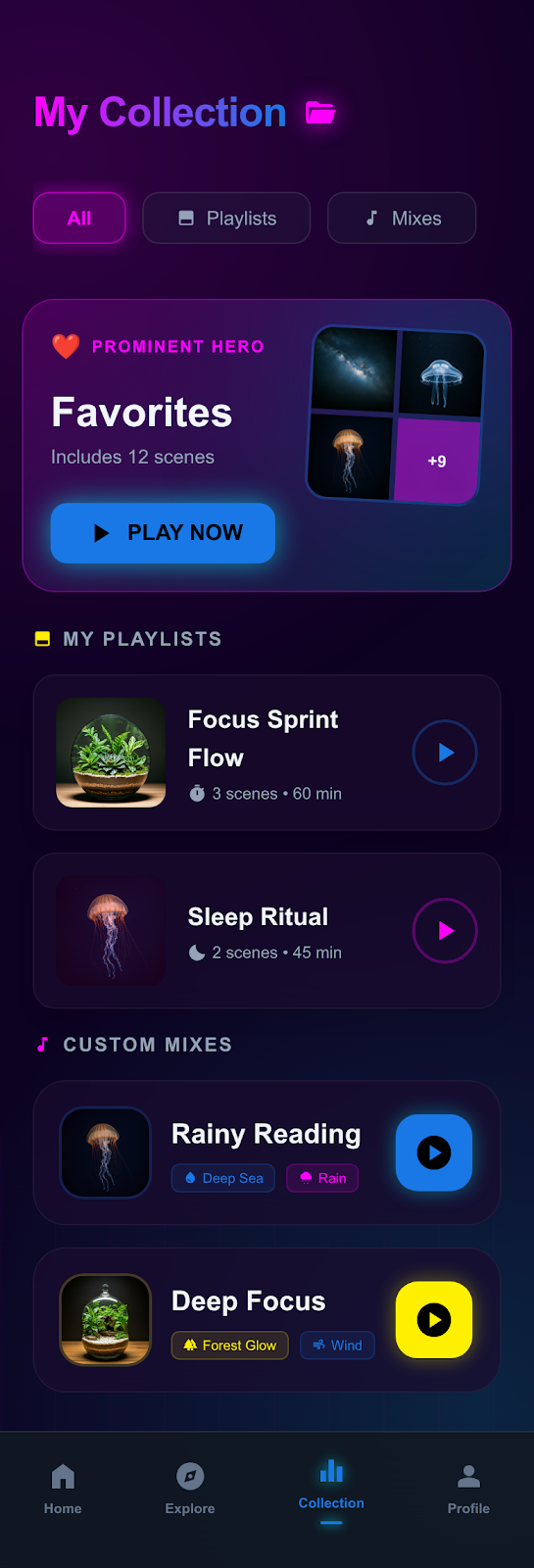
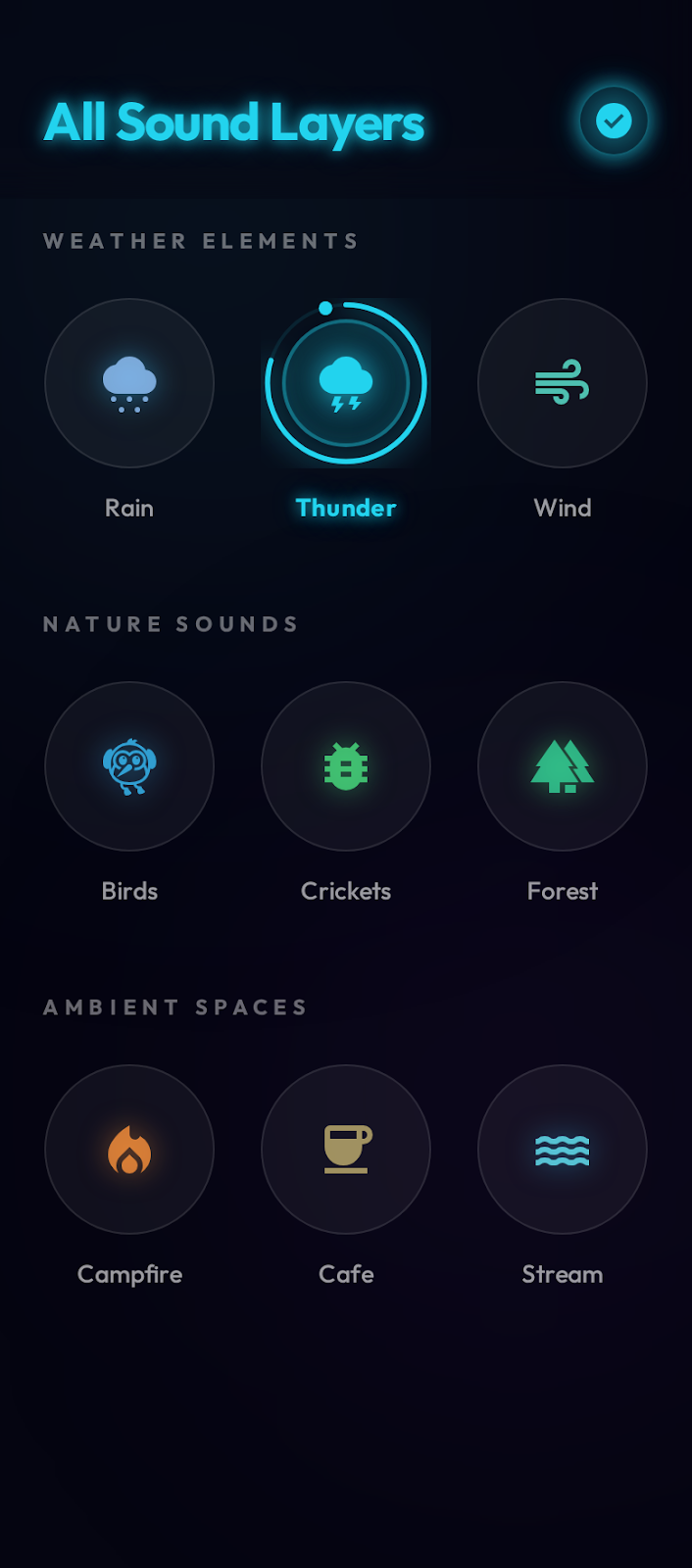
On Saturday, August 15, 2026, the Moodbeez Editorial Team reviewed the current MoodApp repository and confirmed the following product facts that are relevant to focus after a chat interruption. The current app targets both iOS and Android. The player flow includes Add Sounds, Save Mix, and song download controls. The collection flow includes saved playlists, custom mixes, and an offline-download section. The localization layer includes Traditional Chinese labels for these areas, including entries such as Add Sounds, Offline Downloads, and download-confirmation strings. These are product observations, not medical evidence.
The offline behavior is especially relevant to restart friction. The current offline-playback documentation and database code indicate that downloaded songs resolve to a local playable file path when present, and downloaded environment sounds are also registered locally. In plain terms, once a user has prepared a mix in advance, the app is built to start that prepared material without depending on a fresh stream every time. That matters on flights, trains, or unstable-signal commutes where the real cost of an interruption is often followed by the extra cost of searching again.
What this artifact does not prove
The artifact is honest but limited. We did not run a timed comparison against silence. We did not compare wind versus rain versus brown noise. We did not test cross-device sync behavior between an iPhone and an Android phone, so this page does not claim that the exact same saved mix follows a user between devices automatically. We also did not measure concentration scores, writing speed, or message-response quality. The claim is narrower: MoodBeez currently shows a saved-mix workflow, a selectable ambient-layer workflow, offline download support, and Traditional Chinese localization that plausibly reduce restart friction after a chat interruption.

Where MoodBeez fits after a chat interruption
The matching product entity page is MoodBeez functional music app. MoodBeez fits this use case when the problem is not “I need more motivation,” but “I need one ready-made lane that is easier to return to than another round of browsing.” In that narrower role, the useful product facts are the adjustable ambience layers, saved mixes, offline downloads, and localized interface options that reduce setup decisions after the interruption has already spent some of your attention.
That does not mean a saved mix is always better than silence. Some people restart faster in a quiet room. Some tasks are too language-heavy for any background audio. Some listeners find wind or noise irritating. A good recommendation here is not “everyone should use sound.” It is “if sound helps you, keep one prepared option that does not make you search again.” That is also why the commercial relationship stays explicit: MoodBeez is the publisher’s own product, and the product section is separate from the evidence section.
Who, how, and why this page was produced
Who created it: Moodbeez Editorial Team.
Relevant expertise and limits: The team covers product workflow, Flutter-app feature verification, audio export, and source-led digital-health editing. We are not presenting ourselves as neurologists, psychiatrists, or occupational-health clinicians, and this page was not medically reviewed.
How it was produced: On Saturday, August 15, 2026, the team reviewed current interruption and notification studies plus safe-listening guidance; built the 30-second sample above in ffmpeg from one local MoodBeez focus file and one local MoodApp wind layer; verified the export technically; and reviewed the current MoodApp codebase and internal product screenshots for player, mix, localization, and offline-download behavior. Research synthesis, English drafting, and Traditional Chinese localization used editorial AI assistance followed by manual review and correction by the Moodbeez Editorial Team against the cited sources.
Why it exists: to help readers understand focus after a chat interruption without exaggerating the evidence, and to publish one reproducible sample plus one accountable product-workflow check that may reduce restart friction for the readers who actually want an audio-based re-entry routine.
Observations and limitations: The sample build and product-workflow verification are first-hand. The interpretation is editorial. No claim is made that this mix fixes productivity, prevents distraction, or suits every type of knowledge work.
- Altmann, Trafton, and Hambrick: momentary interruptions can derail the train of thought
- PubMed: longer interruption recovery depends on working memory and task reconstruction
- PubMed: the attentional cost of receiving a cell-phone notification
- University of California, Irvine: interrupted work can feel faster while increasing stress and frustration
- WHO: safe-listening guidance for long hours of personal-audio use
Watch the vertical video version on YouTube
Keep one restart lane ready before the next ping
If your focus after a chat interruption usually leaks into more browsing, save one plain mix in advance so the return does not begin with another search.
Watch the vertical videoFAQ
Can one chat reply really break focus that much?
It can, especially when the interrupted task depends on remembering your place. The exact cost varies by person and task, but short interruptions can damage placekeeping and make the next line harder to recover than expected.
Is a saved mix always better than silence after a chat interruption?
No. Silence may work better for some listeners or some language-heavy tasks. A saved mix is useful when it lowers restart friction for you; if it becomes another thing to evaluate, it is the wrong tool for that moment.
Can MoodBeez save a recovery mix and download its tracks for offline listening?
Yes. The current product code and internal screens support saved mixes, player downloads, and locally registered environment sounds. This page does not claim that the exact sample is a built-in preset or that the app guarantees concentration.