Baby White Noise in a Hotel Room: How to Keep the Volume Safe
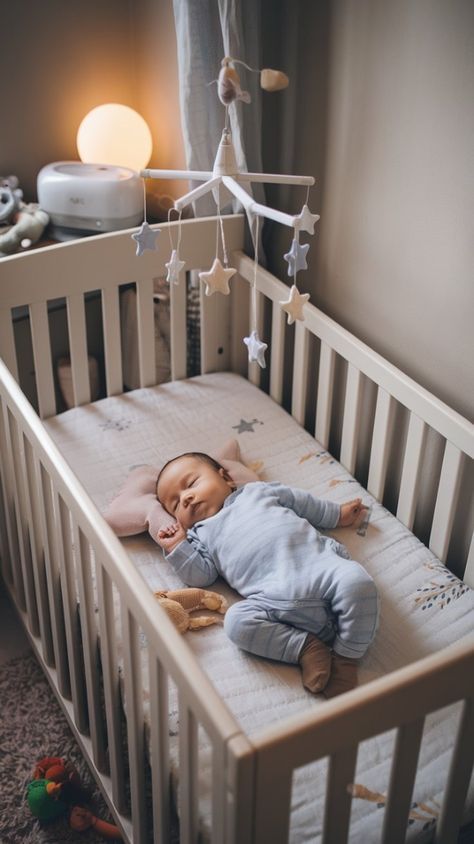
Baby white noise in a hotel room can be useful for a narrow reason: it may make an unfamiliar room feel less jumpy in the first few minutes after lights go down. It is not the main safety job, it does not make a bad sleep surface acceptable, and it should not become a reason to turn a phone or speaker up too far beside the crib.
This page stays with that narrow travel question because it is the honest one many parents face: if the room is strange, the hallway is noisy, and you want a steadier sound floor, how do you use white noise without sliding into an unsafe volume or an unsafe setup? The answer here is science-first and limited. We explain what current infant-sleep and noise guidance supports, document one original 30-second sample, and report one truthful MoodBeez workflow verification from Monday, August 17, 2026.
Play the documented hotel-room sample
Direct MP3 link if the embedded player does not start in your browser.
Method: one local MoodBeez baby-soothing track file, mp3/baby_soothing/s_1772418613543.mp3, was trimmed from 52 seconds to 82 seconds and mixed with a very low synthetic brown-noise layer generated in ffmpeg with anoisesrc=color=brown. The music layer was set to −19 dB and the brown-noise layer to −35 dB, then the result was encoded as a 192 kbps MP3 and rechecked in ffmpeg for decode errors after export.
What this sample is: a reproducible low-detail sound floor for the first unfamiliar minutes in a hotel room or other travel sleep space. What it is not: proof that white noise is necessary, proof that longer playback is better, or permission to place a speaker next to the crib.
Created and export-tested by the Moodbeez Editorial Team on Monday, August 17, 2026 in a local Mac-based workflow. This was an artifact build, not an infant sleep-outcome trial. Start low, keep the device away from the baby's head, and stop if the room needs a different response.
What baby white noise in a hotel room can and cannot do
Parents often reach for white noise on trips because the room is new, the hallway noise is irregular, and the familiar home sound floor is gone. That instinct is understandable. The more careful question is not whether white noise is “good” or “bad,” but what problem it is realistically solving.
A small settling effect is plausible, but the evidence stays limited
A very small older randomized trial indexed at PubMed found that 16 of 20 neonates fell asleep within five minutes with white noise, compared with 5 of 20 without it. That result is interesting, but it is too small and too old to carry a sweeping claim. A broader 2021 systematic review on noise as a sleep aid, also indexed through PubMed, concluded that the overall evidence quality for continuous noise improving sleep was very low.
So the fair reading is modest. In some situations, a plain and steady sound may help mask environmental variation and make settling easier. That does not mean every baby needs it, every room benefits from it, or more hours of playback lead to better sleep.
Noise risk rises quickly when the device is too close or too loud
Safety guidance is stronger than the effectiveness evidence. HealthyChildren.org notes that infant sleep machines can produce hazardous noise levels and advises parents to place the machine as far from the baby's head as possible and use it only for a short time. A 2014 Pediatrics-related measurement study indexed at PubMed reported that all 14 tested infant sleep machines exceeded 50 dBA at 30 cm. A later 2021 measurement paper, also indexed at PubMed, found that some devices can still reach hazardous outputs at higher settings.
A 2024 review indexed at PubMed went further and warned that incorrect continuous white-noise use in young children may carry hearing, speech, and learning risks. That does not mean a short, low-level travel cue is automatically harmful. It means the burden of care should sit on distance, restraint, and clear limits, not on “it is for sleep, so it must be safe.”
Hotel-room sleep safety matters more than the sound choice
If you remember only one thing from this page, make it this: in travel situations, the sleep surface comes before the soundtrack. White noise is optional. Safe infant sleep setup is not.
Start with the crib or playard, not the app
HealthyChildren.org's safe-sleep guidance says babies should be placed on a firm, flat sleep surface and may sleep in a crib, bassinet, portable crib, or play yard that meets safety standards. It also says the sleep surface should stay clear except for a fitted sheet. That matters even more on trips, when adults are tired and the room is improvised.
The travel-specific hotel safety guidance from HealthyChildren.org adds two practical points that fit this reader question well: do not relax safe-sleep habits in a hotel room, and use a portable crib or packable playard rather than bringing the baby into the adult bed. The same page notes that a familiar crib sheet may help a baby in a new place, which is a simpler and often more important travel cue than adding more sound.
Keep the device away, keep the volume modest, keep the session short
For baby white noise in a hotel room, a safer decision pattern is straightforward: position the speaker or phone well away from the crib, keep the sound low enough that you are not trying to overpower the room, and use it for a short settling window rather than as an automatic all-night reflex. If the only way the setup feels effective is by moving it close to the baby's head or turning it up aggressively, that is a sign to stop and rethink the plan.
It is also important not to let technology weaken supervision. The same hotel guidance from HealthyChildren.org explicitly says not to leave a child alone in the hotel room, monitor or no monitor. Sound should support routine, not create false confidence.
What we verified in MoodBeez on Monday, August 17, 2026
The first-hand product work for this page was a workflow verification, not a claim that the app itself determines safe decibel levels for babies. We checked the current published product entity page, the current MoodApp Flutter codebase, the offline-playback flow notes, and the current localization strings.
Here is what was directly verified. The current offline-playback documentation states that playback checks client.sqlite.local_files; when a record shows is_downloaded=1 and the local file exists, the playable path resolves to a local file:// URL instead of the remote stream. The current app strings include Add Sounds, Save Mix, OFFLINE DOWNLOADS, and Downloaded for offline use in English, alongside Traditional Chinese labels such as 離線下載 and 已下載可離線播放. The current app code also starts its theme from ThemeData.dark(), which is relevant when a caregiver is trying to make a small change in a dim room. The current product entity page and store identities confirm MoodBeez is available on iOS and Android.
Those facts matter because hotel-room use is often a low-light, low-patience, unstable-Wi-Fi situation. A saved mix and a downloaded track can reduce re-searching and buffering when you want one plain setup ready before bedtime. What this page did not verify is a calibrated room-sound measurement, a pediatric hearing-safety certification, or a live hotel-room trial across multiple devices. MoodBeez is a playback tool, not a sound level meter.
Where MoodBeez fits if you want baby white noise in a hotel room
The matching product entity page is MoodBeez functional music app. MoodBeez fits this use case when the pain point is not “I need an app to solve baby sleep,” but “I want one calm, already-prepared sound setup that I can open quickly in a dim room without depending on hotel Wi-Fi.” In that narrower role, the useful currently verified facts are the iOS and Android availability, saved mixes, adjustable sound layers, offline downloads, dark-theme interface, and Traditional Chinese localization.
If the real issue is the whole unfamiliar-room effect rather than infant care, our earlier first-night-effect sleep guide explains why hotel rooms feel harder than home for adults too. If your harder baby moment is after guests leave and the room is overstimulated, the closer match is the post-visitor room-reset sample. This page stays narrower: how to think about baby white noise in a hotel room without letting convenience outrank safety.
Who created this page, how it was made, and why it exists
Created by: Moodbeez Editorial Team, the publisher of the MoodBeez app.
Review status: The English article and the Traditional Chinese localization were reviewed by the same editorial team on Monday, August 17, 2026 for factual consistency, safety boundaries, commercial disclosure, and meaning accuracy. This page was not medically reviewed by a clinician.
How this page was produced: The team reviewed current independent and official sources on infant safe sleep, travel crib safety, child noise exposure, and white-noise measurement studies; created the original 30-second sample above in ffmpeg from one local MoodBeez baby-soothing track plus synthetic brown noise; verified the MP3 export; and checked the current MoodApp codebase, localization strings, app theme, offline-playback flow notes, and published product entity page for the product statements used here. Drafting, metadata, localization support, and formatting used editorial AI assistance followed by manual review and correction.
What is first-hand here: the exact sample build, the trim and gain settings, and the code-backed verification of current dark-theme, localization, and offline-routing behavior relevant to travel use.
What was not tested: no calibrated in-room decibel measurement, no hotel-room field trial with infants, and no claim that this sample or any app mix is safe at any arbitrary volume or distance.
Why this page exists: to help parents and caregivers think clearly about hotel-room white noise for babies before convenience, stress, or poor Wi-Fi push them into louder or less thoughtful choices.
- HealthyChildren.org: firm, flat infant sleep surfaces and portable crib/play yard guidance
- HealthyChildren.org: child noise exposure and placing infant sleep machines far from the baby's head
- HealthyChildren.org: hotel-room safe-sleep habits, portable cribs, and familiar crib sheet guidance
- PubMed: small randomized trial of white noise and neonatal sleep induction
- PubMed: infant sleep machines and hazardous sound pressure levels
- PubMed: hazardous sound outputs of white-noise devices intended for infants
- PubMed: systematic review on noise as a sleep aid
- PubMed: review of continuous white-noise exposure during sleep in infants and children
If baby white noise in a hotel room helps, prepare it before bedtime
The useful move is not chasing a stronger sound. It is setting one plain, low-detail lane in advance so you are not rebuilding the room while everyone is already tired.
Watch the vertical videoFAQ
Should baby white noise stay on all night in a hotel room?
Not by default. Current guidance is more comfortable with short, restrained use than with treating white noise as an always-on requirement. If the room only feels manageable when the sound stays loud or very close, rethink the setup.
How close can I place the phone or speaker to the crib?
The guidance from HealthyChildren.org is to place it as far from the baby's head as possible and use it only briefly. Do not attach it to the crib, set it beside the mattress, or aim it directly at the baby's ears.
Can MoodBeez tell me whether the volume is safe?
No. Current verified product behavior covers saved mixes, offline downloads, dark-theme playback, and localization. It does not replace a sound-level check or pediatric judgment about whether the room setup is appropriate.