Should You Leave White Noise On All Night?
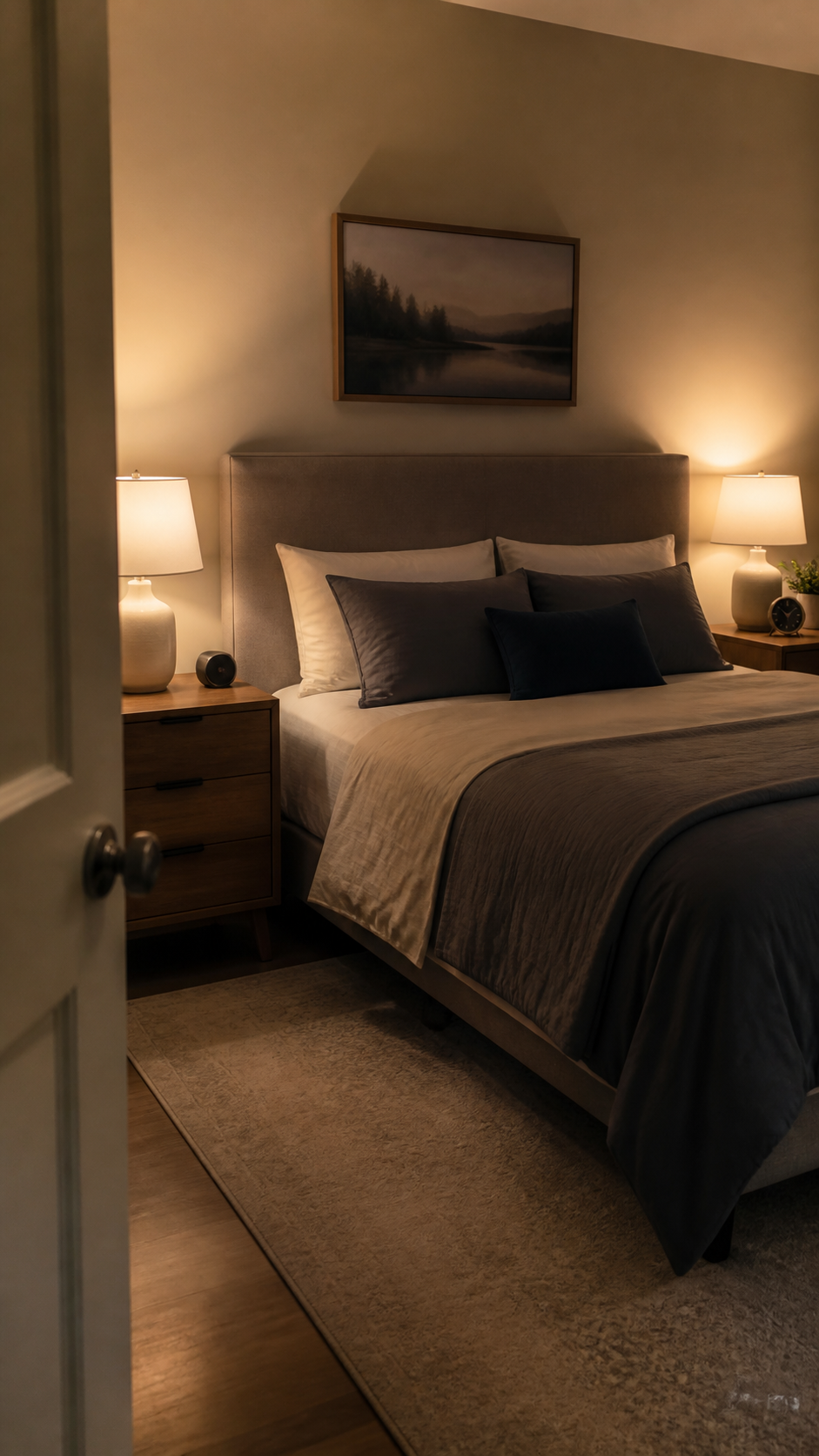
Should you leave white noise on all night? There is no universal yes. A steady sound may make an intermittent traffic burst, a neighbour, or a partner’s movement less noticeable for some adults. It can also become another sound exposure, disturb someone else in the room, or feel irritating. The sensible answer is not to force it through the night: decide from comfort, safety, and the particular noise you are trying to manage.
This guide is for adults considering continuous background sound at bedtime. It starts with what the evidence and hearing guidance can—and cannot—say. It then documents one low-level Moodbeez listening artifact and a practical trial. Moodbeez publishes this page and develops MoodBeez. Neither the app nor this sample diagnoses, treats, prevents, or cures insomnia or any other condition.
What continuous white noise can and cannot do
White noise is a broad-band sound. In a bedroom, the idea is usually masking: a steady backdrop can reduce the contrast of an unpredictable sound, so the interruption may be less salient. That is a plausible practical mechanism, but it is not the same as proving better sleep. The systematic review by Riedy and colleagues found very-low-certainty evidence for continuous noise as a sleep aid and noted that studies varied sharply in sound, method, and results. Another adult review found the evidence was not strong enough to establish effectiveness.
That uncertainty matters. A person may prefer a steady sound in a noisy building without it improving sleep onset, awakenings, or next-day function. Conversely, someone can sleep well without any audio. Treat continuous white noise as an optional environmental adjustment, not as a medical intervention or a replacement for assessment of persistent sleep difficulty.
Masking is most relevant to intermittent sounds
A continuous sound is most worth considering when the problem is contrast: an occasional door, a variable road noise, or a partner’s isolated movement. It cannot make a loud environment healthy, and it cannot safely cover alarms, a child, a dependent adult, a smoke alarm, or an emergency. The World Health Organization notes that excessive environmental noise is associated with sleep disturbance and other health effects; reducing the unwanted source is preferable when that is possible.
Comfort is a valid outcome
Some listeners find a broadband sound harsh, pressing, or harder to ignore than the original interruption. That is enough reason to stop. You do not need to “get used to” an unpleasant sound in order to sleep correctly. A room can be quieter, a fan can be relocated, or the audio can be switched off; these are all legitimate results of a trial.
Why all-night listening needs a hearing check
Duration is part of sound exposure. The National Institute on Deafness and Other Communication Disorders says that sounds at or below 70 dBA are unlikely to cause hearing loss even after long exposure, while long or repeated exposure at or above 85 dBA can cause harm. A phone volume slider does not tell you the dBA at your ear: device, speaker, headphones, distance, and room all change it. This article therefore does not offer a percentage or gain value as a safe prescription.
For an overnight routine, use a distant speaker rather than sleeping in earbuds or headphones, keep the level low enough that it is plainly background rather than the focus of attention, and keep essential sounds audible. Turn it down or off if you notice ringing, muffled hearing, discomfort, or a need to keep increasing it. If you suspect hearing loss, tinnitus, or a sleep disorder, seek assessment from a qualified clinician or audiologist instead of trying to solve it by adding more sound.
A reversible three-night decision for continuous white noise
Do not test several changes together. Choose three otherwise ordinary nights when you do not need to hear a critical alert. On the first, use your normal bedroom with no added audio. On the second, use a low, steady sound from a speaker for only the first part of the wind-down; set a timer to stop it after you are asleep. On the third, if the second night was comfortable, let the same speaker sound continue. Keep the source, position, and level unchanged.
Each morning, record only a few observations: Was the sound comfortable? Did it cover a specific interruption? Did you wake feeling you wanted it off? Did it interfere with a partner, an alarm, or your ability to hear what mattered? This is not a sleep study and cannot prove cause. It is enough to choose the simpler setup: no sound, a sleep timer, or continuous sound at a low and acceptable level.
Our documented all-night listening artifact
Direct MP3 link if the player does not start.
Creator, date, environment, method, and observation: On August 26, 2026, the Moodbeez Editorial Team created and export-tested this 30-second artifact in a quiet Mac-based editorial workspace. We trimmed the local repository source mp3/sleep/Pink Noise - Calming Rain, Loopable.mp3 to 30 seconds and set it to 0.045 linear gain. We generated synthetic pink noise with ffmpeg anoisesrc=color=pink:amplitude=0.06, set that layer to 0.12 linear gain, mixed the two layers without normalization, limited peaks at 0.60 full scale, encoded a 192 kbps MP3, and decoded the final export with ffmpeg without errors. At deliberately low desktop-speaker volume, our observation was a continuous, nonverbal low-detail bed with no abrupt start.
Limits: This is a reproducible production record, not a clinical trial, participant test, hearing measurement, or proof that continuous sound improves sleep. We did not measure device output, sleep onset, awakenings, partner impact, or any listener outcome. The listed gains are build settings, not a safe-volume prescription.
Where MoodBeez fits after the safety decision
The MoodBeez product page describes iOS and Android availability, independently adjustable ambience layers, saved mixes, and offline downloads. If you have already established that a quiet sound is comfortable, a prepared mix can avoid an algorithmically changing stream at bedtime. Strengthened offline data-persistence rules are intended to let prepared tracks play without streaming delay or mobile-data use on a flight or in unstable-signal camping areas; download a track before relying on it. The deeply localized interface is designed for intuitive low-light bedtime operation.
Those are product-convenience statements, not sleep claims. MoodBeez does not make a sound appropriate for every bedroom, and it cannot replace a partner conversation, a quieter room, or medical care. For a related but different question, see our pink noise and a snoring partner guide and our hotel first-night-effect guide.
Who made this, how, and why
Who: Moodbeez Editorial Team, the product and editorial team behind MoodBeez. Our relevant scope is product workflow, audio export, and source-led digital-health editing. We are not physicians, sleep specialists, or audiologists, and this article did not receive medical review.
How: We reviewed the independent systematic reviews and public-health guidance linked below, created and decode-tested the dated audio artifact, checked limited product statements against the current product page, and editorially reviewed the English and Traditional Chinese versions for matching facts, cautions, commercial relationship, and intent. Editorial AI assisted drafting, metadata, and localization; the team reviewed and corrected the result. See our About, editorial, sourcing, review, and corrections standards.
Why: This page exists to help adults decide whether an all-night sound routine is worth keeping, shortening, or stopping—not to capture a broad sleep keyword or sell audio as treatment.
Watch the vertical-video version on YouTube
Keep the routine easy to reverse
If the sound becomes another thing to manage, set a timer or turn it off. The best overnight setting is the one that is quiet enough, safe enough, and genuinely tolerable for everyone affected.
Watch the vertical videoFrequently asked questions
Is it safe to leave white noise on all night?
Safety depends on actual level, distance, duration, and whether important sounds remain audible. Use a low speaker level rather than sleep headphones, and do not treat an app-volume percentage as a hearing-safety measurement.
Does white noise help everyone sleep?
No. Reviews of adult sleep research find mixed, low-certainty evidence. It may make a particular intermittent sound less noticeable for some people, but it can also be unwanted or disruptive.
Can MoodBeez play a prepared sleep mix offline?
The current product page describes saved mixes and offline downloads on iOS and Android. Download the needed track before relying on it; offline playback is a convenience feature, not a treatment claim.